
The Room Sounds Wrong. The Microphone Isn't the Problem.
Bad acoustics don't announce themselves as a problem. They just make people stop wanting to talk in that room. Consider this your sound advice.

What Is Sound Masking?
Sound masking is engineered background sound, tuned to the frequency range of human speech and played quietly through the ceiling, so a conversation ten feet away becomes an unintelligible murmur instead of a word-for-word broadcast. It isn't noise cancelling, which removes sound. It isn't white noise from a fan in the corner. It's a calibrated signal built to cover speech, and it only works when it's tuned to the room.
An office needs it wherever private conversations happen without full walls: open floor plans, glass offices, cubicles near conference rooms. That's the speech privacy problem in plain terms, the conversation in the corner office that the row of desks outside can follow word for word. Masking closes that gap without adding a wall.


The Options, and What Each One Fixes
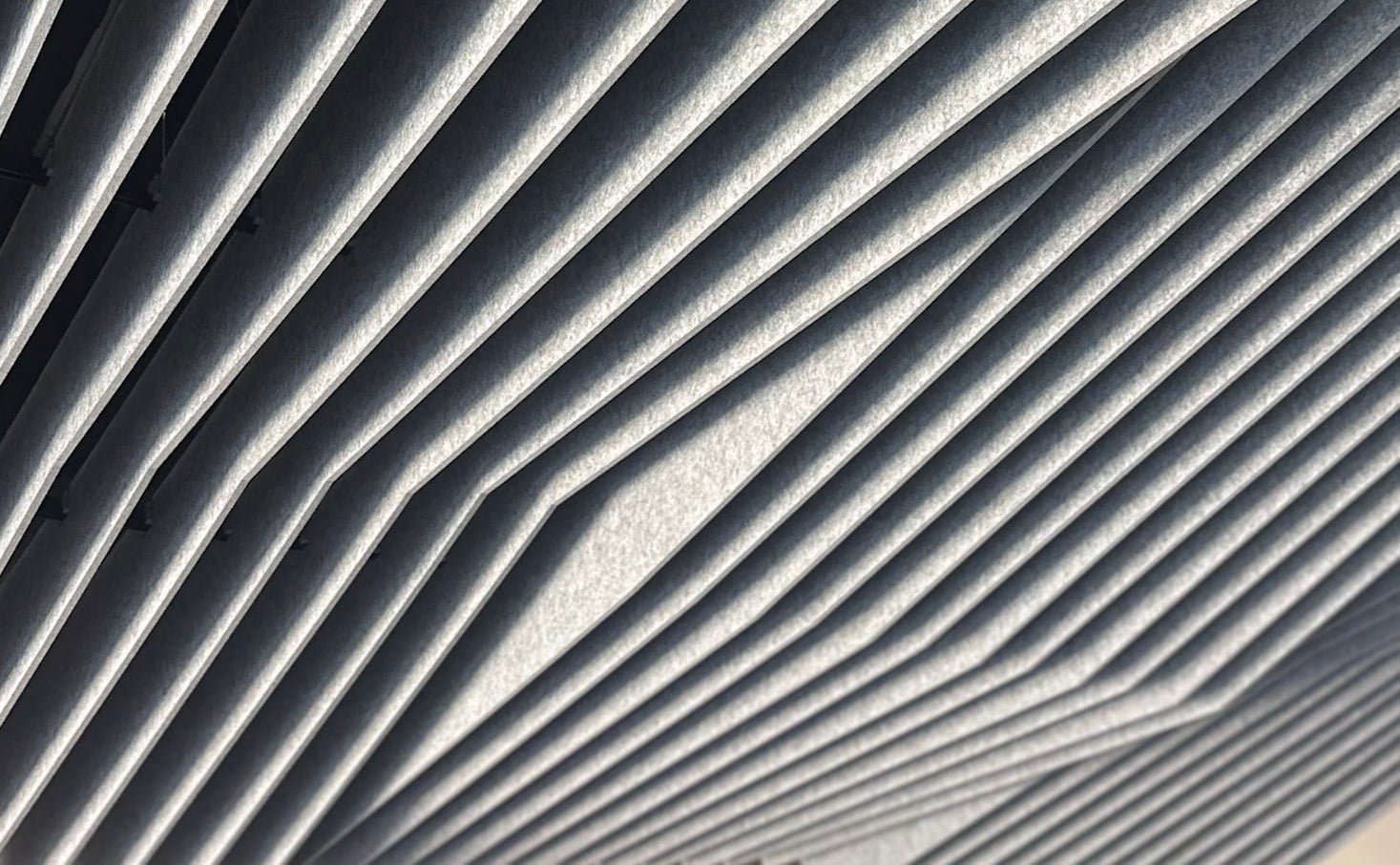
Sound masking fixes privacy. It covers speech so it can't be understood at a distance, but it does nothing for echo. Acoustic treatment, panels and baffles and ceiling tiles, fixes reverberation in a room with too many hard surfaces, but a perfectly treated room can still let every word carry.
None of these substitute for each other, and none require tearing anything out. Masking runs through the ceiling and layers onto an existing space; most treatment mounts to walls or ceilings without construction. An open office can improve dramatically without a single wall going up. Layout and materials, soft furniture and carpet and staggered desks, reduce how far sound travels and help both a little without solving either. Quiet zones and pods solve privacy by removing the conversation from the floor entirely. Voice lift and assistive listening amplify a speaker evenly so the back row hears what the front row hears, which is an intelligibility fix, not a privacy one.
What Does Sound Masking Cost?
Cost scales with square footage, ceiling type, and how many independent zones the space needs. A small, single-zone space sits at the lower end. A larger floor plate with multiple zones or an exposed ceiling costs more, since exposed ceilings need a different speaker mounting approach. The masking system itself is rarely what drives the price up: the ceiling type and zone count are.
Why Acoustics Matter
Beyond the Meeting
Constant background noise and poor speech privacy are measurable drains on focus, not just a comfort issue. Intelligible background speech is one of the hardest sounds for the brain to tune out, which is why untreated open-plan offices report higher distraction and lower task performance. Fixing the acoustics removes a low-grade source of fatigue that most people blame on the workday rather than the room.

Acoustic Treatment

Sound Masking Systems

Speech Intelligibility Optimization

Assistive Listening & Voice Lift

Performance Audio Systems


Featured Project
A workplace designed for collaboration across meeting spaces and shared environments.
• Acoustic lobby design
• Conference rooms with integrated AV
• Multipurpose space with LED wall
• Neat systems in small meeting rooms
• Café all-hands space
From the blog

Why Is Audio Quality the Most Important Part of a Conference Room?
Learn why audio quality is critical for hybrid meetings, speech intelligibility, and conference room design, and how better sound drives engagement.
Sound Transmission Class, Ratings & Chart: Your Complete Guide
Sound transmission class, or STC, is an important metric to pay attention to when planning the acoustics for your spaces. Get all the details here.
Determining Sound Absorption Coefficient Needs
Being informed about the right materials for acoustic treatment is possible when you understand the underlying concept. Learn all you need on the blog.
